
Read Macon County's Owner-of-Record Card
Georgia's Department of Revenue links the Macon QPublic search as the official assessor route into Macon County parcel records. A live parcel card does not always load. So treat the owner field as Owner/Taxpayer, pending confirmation. It is a clue, not a title opinion.
This Macon County QPublic screen marks the official starting point for checking the present tax-roll owner in Macon County property records.
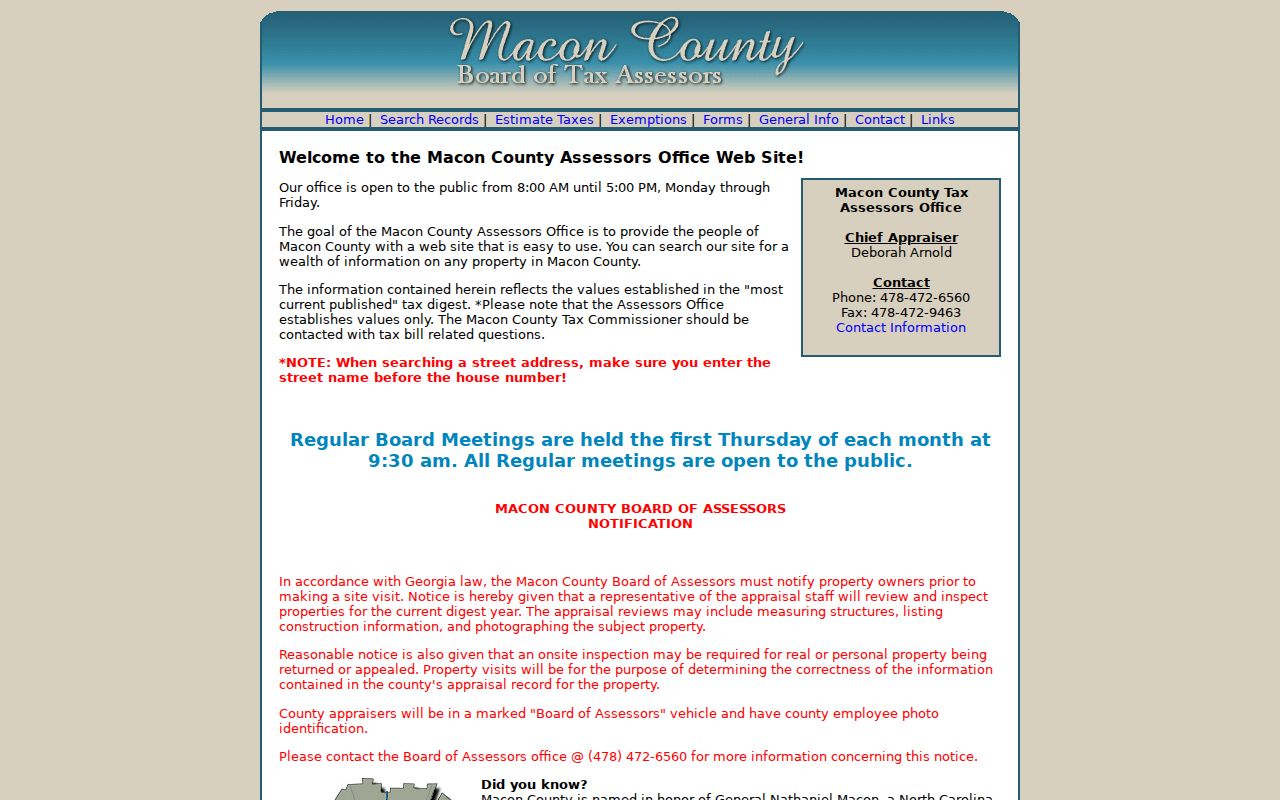
The screen is only a gateway. Copy the live Owner/Taxpayer field with its year, then compare it against the newest recorded grantee before drawing any conclusion from Macon County property records.
| Owner/Taxpayer | Present tax-roll name; exact Macon label not confirmed |
|---|---|
| Mailing Address | Destination for tax notices, which can differ from the property |
| Situs Address | Physical parcel location used to anchor the search |
| Parcel and legal description | Keys for matching the land across systems |
| Last sale or deed reference | Possible transfer lead; exact display not verified |
A PO box or out-of-county mailing address never changes the situs. The grantee can be an LLC or trust. An individual may sign for it, so note the signing capacity beside every field in the Macon County parcel record.
Why the Macon Owner Roll May Trail a Closing
The assessor performs annual appraisal work and sets fair market value as of January 1. Official sources do not state a fixed sale-to-roll delay for Macon County. A deed may be executed on one date, recorded later, and then reach the assessment system on its own cycle. Never promise that a name changes within a set number of days.
Recent sale warning. The tax roll can lag a closing. The newest recorded deed with the matching legal description is the stronger current-owner check.
Write down both names. Record the tax-roll owner and the latest deed grantee, each with its date and reference, so your Macon County notes preserve what the sources actually show.
Separate Macon Situs and Mailing Addresses
The situs locates the land itself. The mailing address tells Macon County where to send tax correspondence. A farm, entity, trust, estate, or owner living elsewhere can produce a different mailing destination, so treat a mismatch as a clue rather than proof of occupancy.
- Owner of record
- The party shown in the selected official record.
- Assessment roll
- The county parcel and value record used for tax administration.
- Situs
- The physical property location.
- Recording lag
- The interval between a transfer, recording, and updates elsewhere.
Note: Postal city names and municipal limits can differ in Macon County, so match the parcel number and legal description whenever an address seems ambiguous.
Verify a Macon Entity Owner by Exact Name
An LLC or corporation on a Macon County parcel card needs an exact-name check. Copy the name letter for letter. The Georgia Secretary of State Business Search then returns the control number, registered agent, principal office, and filing history. Those fields separate lookalike entities. The control number matters most. The agent or principal-office address is not automatically the parcel's situs or mailing address, so return to the deed for the grantee, signing capacity, and land description. For a trust, search trust and trustee names. For an estate, search the decedent, estate, executor, or administrator, and consult Macon County Probate Court when authority needs explaining.
Keep Six Macon Ownership Fields Apart
Keep six Macon County fields apart. Columns work best. A strong current-owner note lists the tax-roll owner, mailing address, situs address, parcel number, legal description, and latest recorded grantee, adding the assessment year, recording date, and book/page or instrument number where shown.
| Question | Source | Answer retained |
|---|---|---|
| Who is on the roll? | QPublic | Owner/Taxpayer and year |
| Which land? | Parcel card and deed | Parcel key and description |
| Who received it? | Latest deed | Grantee, recording date, reference |
| Which entity? | SOS filing | Exact identity and status |
This separation prevents one tax field from becoming a claim that it cannot support.
Confirm the Present Macon County Owner
Move past the parcel card. The GSCCCA Real Estate Index lets you search the roll owner as grantee within Macon County. Match the legal description, parcel clues, and newest recording before concluding, because a shared surname alone is too weak.
- Transcribe the roll owner, parcel, situs, mailing address, and legal description.
- Search that party or entity as grantee in the Macon GSCCCA index.
- Match the land using legal-description terms and cross-references.
- Compare dates and verify the newest deed with the Clerk when needed.
- Owner of record
- The party a particular official record lists.
- Vesting
- The way the recorded instrument states ownership.
- Registered agent
- A statutory entity contact, not necessarily the landowner's personal address.
Use the Oglethorpe Counter When Web Access Stalls
QPublic sometimes blocks web access. GSCCCA image access can depend on subscription rules. Call the Macon County Assessor at 478-472-6560. The Clerk also keeps a public terminal at 121 S. Sumter Street in Oglethorpe and can guide a request by book/page, party, or legal description.
GSCCCA lists regular web access at $14.95 per month and Premium at $29.95 effective July 1, 2025. County clerk terminals stay free. Confirm pricing live. Macon County records before 1991 are directed to the Clerk, though the exact online cutoff is unverified.
Note: A blocked portal is a reason to use phone, counter, and terminal channels, not proof that a Macon County public record is closed.
Watch Later Macon Filings With FANS
The GSCCCA Filing Activity Notification System, FANS, is a free voluntary alert for certain real-estate and personal-property filings matching subscriber criteria. A later filing can surface after a current-owner check on Macon County land. That matters most for undeveloped land.
An alert is not proof an instrument is valid. It may miss events, and it never replaces a title search. Open the cited filing and verify it through the Macon County Clerk.
Compare Macon Closing, Execution, and Recording Dates
A deed can be signed at closing. It may be recorded weeks later. The Macon County tax roll updates on another schedule entirely. No official source states a fixed sale-to-roll interval, so record each date under its own label instead of forcing the sources onto one timeline.
| Date | What it marks | Why it matters |
|---|---|---|
| Execution or closing | When parties signed or completed the transaction | May precede public recording |
| Recording | When the Clerk accepted the instrument | Orders entries in the land index |
| Assessment year | The tax-roll period | May still show an earlier owner |
Cite the supporting date, and flag any newer Macon County filing for inspection.
Resolve a Macon Current Owner After a Death
A deceased owner's name can linger on a Macon County assessment record. This happens while an estate is administered. Search the decedent name and "estate of." Macon County Probate Court handles wills, administration, and authority. The probate file shows who may act. A later recorded deed then shows the actual conveyance of the land. Life estates and remainder interests can also hide inside a short roll label. So read the operative deed rather than assuming the displayed name covers every present and future interest.
Do Not Confuse Macon Tax Status With Ownership
The Macon County tax search and payment service opened on June 2, 2025. It is a useful tool. A tax bill, a payment history, a delinquency, or an exemption can point you to the right parcel number. It can also lead you to the right tax account. Still, none of that replaces the deed. The tax roll names the taxpayer. Deed records name the grantee. Those two facts can differ. Call the Tax Commissioner at 478-472-7031 if the portal will not complete a search.
Use Macon Current-Owner Data Lawfully
Macon County property records support real work. Buyers use them for purchase research, boundary questions, estate matters, fraud prevention, and civic review. They do not authorize harassment or any effort to bypass protected address information, so use a published tax-mailing or business channel only for a legitimate property matter.
Lawful use. Georgia Safe at Home supplies address confidentiality for qualifying survivors. Never use current-owner information to stalk, harass, intimidate, or work around a protected address.